

HANOI APPROVES INVESTMENT POLICY FOR THE INTERCENTRAL NEW TOD URBAN AREA
(Dan Tri) - On March 16, the Hanoi People's Committee issued Decision No. 1166/QD-UBND, approving the adjustment of the investment policy for the Hateco Dong Anh New Urban Area Project (commercial name: The InterCentral), developed by Hateco Group in Vinh Thanh Commune (former Dong Anh District)
The InterCentral is developed following the TOD (Transit-Oriented Development) model—an urban ecosystem integrated with the public transport network, aligning seamlessly with Hanoi's long-term urban development orientation within a 100-year vision.
Situated in the Ring Road 3 area, right at the northern gateway of Hanoi, The InterCentral connects directly to the stations of two crucial urban railway lines: Metro Line 4 and Metro Line 6. Spanning an area of over 42 hectares with a total investment capital exceeding 25,000 billion VND, the project, upon completion, will fully accommodate the residential and professional needs of more than 18,000 citizens. It is expected to create a new development momentum for the real estate market in the northern part of the capital, against the backdrop of strategic transport infrastructure entering an acceleration phase.
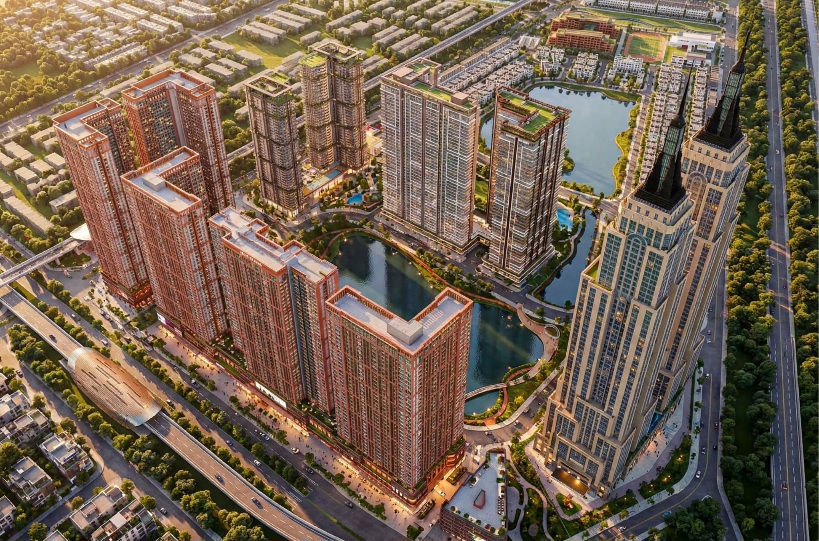
Overall perspective of The InterCentral Urban Area - A new planning highlight at the northern gateway of the capital (Photo: the Investor).
The Future City and the Shift in Planning Mindset
The Hanoi real estate market in recent years has witnessed a shift towards new growth poles, in which the area north of the Red River is still evaluated as a land with massive potential but yet to be exploited commensurately.
In this context, the emergence of The InterCentral urban area materializes the trend of the TOD model: optimizing high-density spatial development closely linked with arterial public transport axes.
The project is planned following a compact city model, not only in quantity but also in quality, where living spaces, workspaces, and infrastructure are synchronously organized, aiming for a modern lifestyle that saves time and urban resources.
At planning plot IV.8.1 with a land fund of over 42 hectares, the Hanoi city's approval to adjust the investment policy for The InterCentral New Urban Area carries a strategic significance for urban development concentrated around major public transport transit hubs, limiting personal vehicles and minimizing emissions.
The 45 to 60-story towers are expected to create a new architectural landscape for the northern gateway of Hanoi. The investor stated that more than 7.2 hectares will be dedicated to water surfaces and nearly 4 hectares to green spaces and internal parks, accounting for a large proportion of the total project area. This is considered a focal point for the sustainable development orientation, striking a balance between a compact city and quality of life.
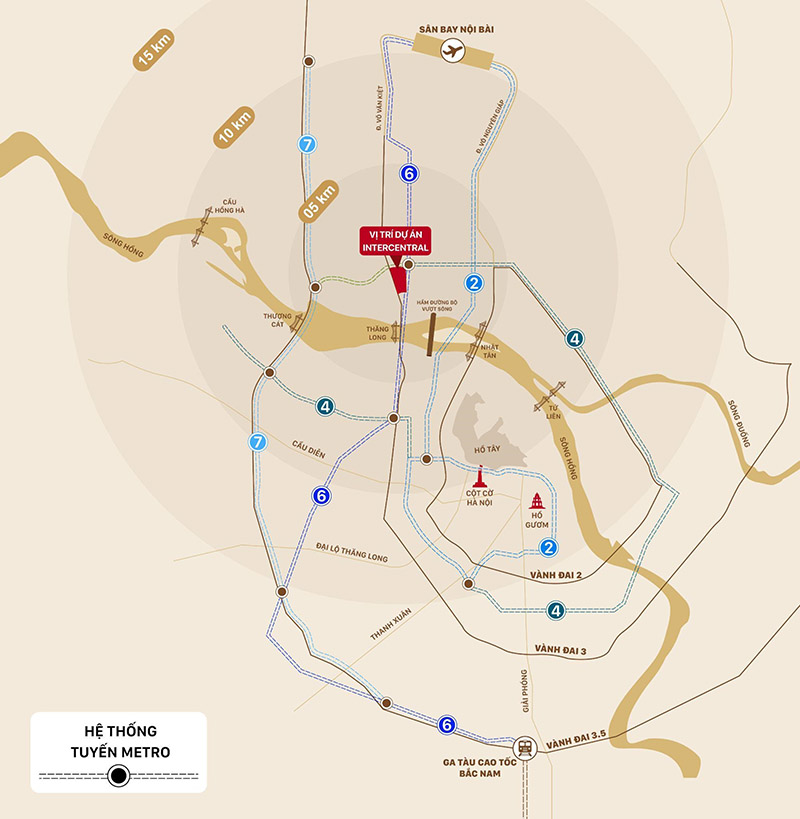 The location of The InterCentral project at the intersection of Vo Van Kiet and Hoang Sa streets, facilitating traffic connectivity under the T.O.D model (Photo: the Investor).
T.O.D Model Urban Area
The standout feature of The InterCentral project is its direct connectivity to the metro system—the core element of the T.O.D (Transit-Oriented Development) urban development model.
According to the master plan, the project is located within the connection zone of two strategic metro lines of the capital: Metro Line 4 and Metro Line 6, enabling large-scale public transport accessibility.
Leveraging this advantage, The InterCentral is evaluated to have the potential to form a Super Hub, an intersection of urban traffic flows, simultaneously creating a vibrant development space for commerce, services, and a modern residential community.
Reality in many major cities such as Tokyo, London, or Singapore shows that TOD urban areas often become new development centers of the city, where real estate values, commercial activities, and the urban pace of life are all vigorously promoted.
Built upon a synchronous infrastructure foundation, the project is planned as a miniature city featuring 10 premium apartment buildings, 2 twin towers functioning as Grade A office complexes, an international hotel, commercial townhouses, a closed villa compound, along with educational and healthcare systems, aiming to cultivate a modern, civilized, and sustainable living community.
Occupying a strategic location amidst the capital's development, the fact that Hateco Group received the adjusted investment policy and will launch the product in the first half of 2026 serves as a solid foundation affirming the investor Hateco's capacity and vision for sustainable urban development.
Beyond the real estate sector, Hateco Group is also known as the investor of major projects in logistics, industrial park infrastructure, and seaport investment, such as the Bac Tien Phong Industrial Zone (DEEP C), Hateco Hai Phong International Container Terminal (HHIT), and Long Bien ICD Dry Port...
On March 16, the investor consortium of Hateco Group and APM Terminals (a member of A.P. Moller-Maersk Group - Denmark) was selected as the investor for the Lien Chieu container port project in Da Nang with a total investment of approximately 45,268 billion VND.
For clients and investors, legal transparency and the robust potential of the investor are the pivotal elements ensuring capital safety. The formation of The InterCentral Urban Area is expected to contribute to transforming the regional landscape and firmly asserting Hateco Group's position as a professional, sustainable real estate developer.
( Dantri.vn)

 No. 1 Huynh Tan Phat, Sai Dong B Industrial Park, Long Bien Ward, Hanoi City, Vietnam
 Phone:
 Email: